
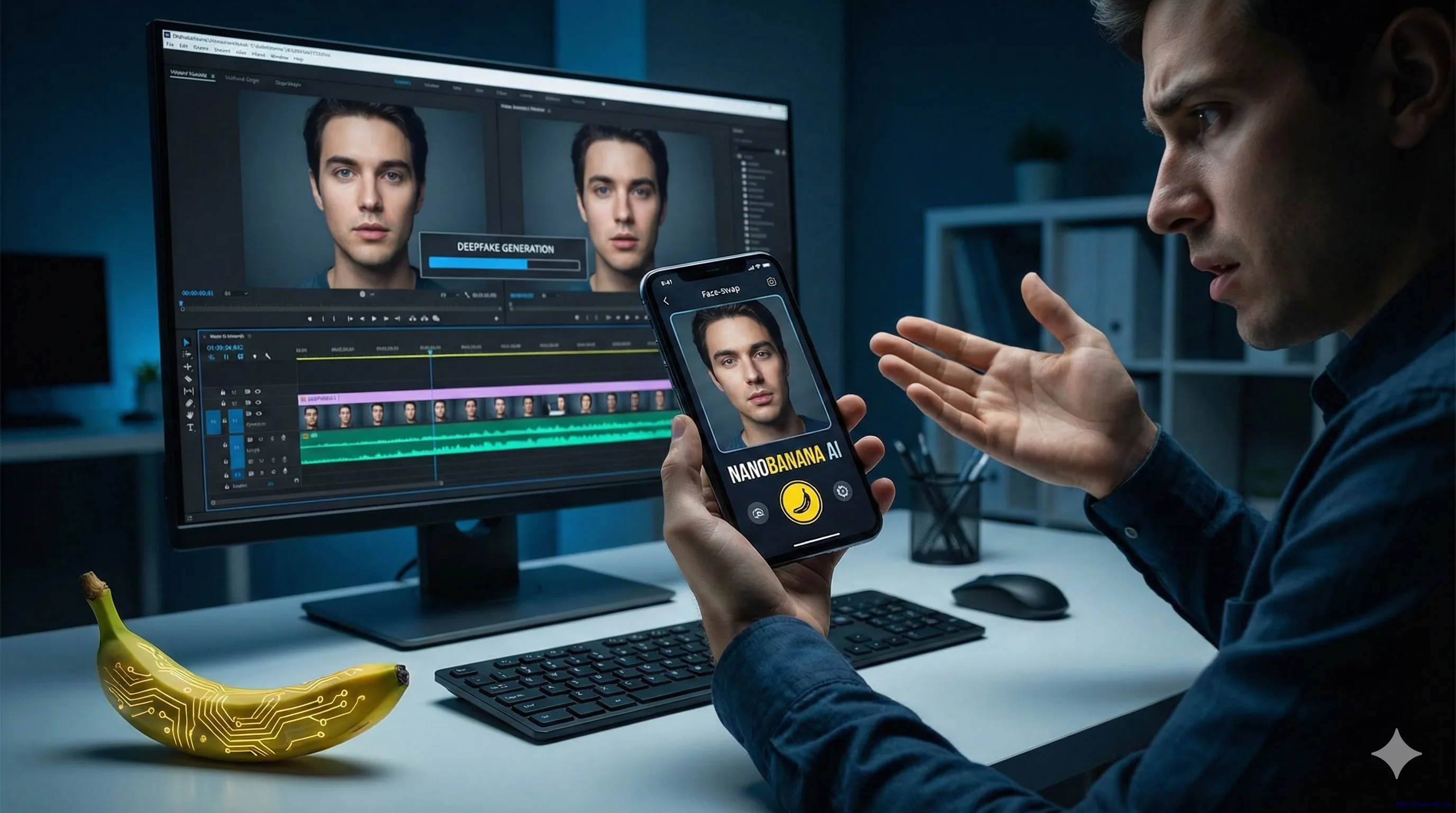
I’m sure you’ve heard the term**“Deep Fake**” in your soup lately. It has become the buzzword, but trust me: behind this buzzword is much more than just a technological curiosity. In this article, we’re going to gut together what they really are, how these tools - which seem like black magic - are changing the rules of the game and, most importantly, how to avoid being spoofed. Make yourself comfortable, and let’s get started.
🎭 🎭 🎭 🎭
What are Deep Fakes?
Imagine if you could put on a perfect digital mask or speak in the voice of your favorite actor just by typing a text. That is, in essence, a*“Deep Fake*”. It is audiovisual content (photo, video or voice) generated by Artificial Intelligence that mimics reality with frightening accuracy.
Although the technology behind it sounds like science fiction (Generative Antagonistic Networks or GANs), the explanation is simple: you put two AIs in competition. One tries to create a perfect fake and the other tries to detect if it is a fake. They learn from each other millions of times until the counterfeit is so good that the human eye (and sometimes the machine) can no longer tell the difference.
The tools that pull the strings
A few years ago you needed a supercomputer and programming skills to do this. Today, unfortunately (or fortunately, depending on how you look at it), it is within the reach of anyone. Here are the tools that are doing it today:
- HeyGen: You’ve probably come across his viral videos. It’s able to dub a video of you into any language, modifying your lip movement to perfectly match the new language. It’s spectacular for business, but it’s a little dizzying how easy it is to use. Spoiler alert: I’m going to leverage this technology to create my own “digital twin”. I want to launch educational videos on YouTube, but I admit that the camera is a bit scary, so I’ve decided to let my avatar do the talking for me. The realism is such that I challenge you to tell us apart, although for the sake of transparency I will always let you know when my clone is in charge.
- ElevenLabs: Watch out for this. It doesn’t do video, it does voice. With just a few seconds of reference audio, it can clone your voice with 99% fidelity, including intonation and pauses for breathing. It’s a favorite tool for today’s phone scams.
- FaceFusion / ReActor: These are somewhat more “geeky” tools (open source) that allow you to change the face of a person in a video for that of another with a single photo. The quality they achieve today on a home PC is cinematic.
- LivePortrait: A recent innovation that allows you to take a static photo and “animate” it by making it follow the gestures of your face in real time through your webcam.
The most impressive thing is that the barrier to entry has disappeared. You no longer need to be a computer whiz; many of these tools work just like a mobile app.
But before we get paranoid, let me tell you that this technology also does wonderful things. Not everything is the end of the world:
- Artistic resurrection: Recreations have been made at the Dali Museum in Florida. They used a Deep Fake to “revive” Salvador Dalí. Visitors could interact with him and the result was endearing and educational.
- Accessibility: There are companies using this to give synthetic voice to people who have lost the ability to speak due to diseases such as ALS, using old recordings of them.
- Film and Dubbing: Allows you to correct filming errors without having to call back the actors, or to adapt lip movements in dubbed movies to make it look like the actor is speaking native Spanish.
Real scams
This is where fact beats fiction. Forget those old stories that are still being told out there, these are some of the recent cases I’ve collected of scams that set off all the cybersecurity alarms:
- The 25 Million Heist in Hong Kong (2024): This one is from a movie. A financial employee received a video call from his chief financial officer (CFO) and other colleagues. They discussed secret transfers. The employee made the transfers ($25 million.) The plot twist? Everyone on the video call except him was Deep Fakes generated in real time. This is the most sophisticated case to date.
- Biden’s “Robocall”: In January 2024, during the New Hampshire primary, thousands of voters received a call with a voice identical to Joe Biden’s asking them not to vote. It wasn’t a copycat, it was an AI. This demonstrated the danger to democracy.
- Virtual kidnapping: Cases are being reported of parents receiving a call from their child crying and asking for help because he/she has been “kidnapped”. The voice is cloned (taken from TikTok or Instagram) and the panic causes parents to pay an immediate ransom without verifying anything.
What we learn from here is crucial**:**
You can no longer trust your eyes or your ears, not even in a live video call.
How to catch an impostor (Detective Mode)
Although AI is getting better every day, it still leaves traces if you know where to look. Here are my personal tricks:
- Ask them to turn in profile: AI has a hard time generating a face when it turns 90 degrees. If you’re on a suspicious video call, ask the person to turn their head all the way to one side. Often the digital mask will “flicker” or warp.
- Notice the blinking: Sometimes they blink too little or too unnaturally.
- Teeth and glasses: These are the weak points. Reflections in glasses sometimes do not match the light in the room, and teeth can look like a white mass with no clear separations.
- The “interruption” test: Try interrupting or talking over it. AI speech systems often have a small delay (lag) when processing the response that is different from that of a fluent human conversation.
Your shield against Deep Fakes
Beyond technology, the best defense is you and your common sense. Here are a few tips:
- Safeword: This is vital. Agree on a secret safeword with your family. If someone calls saying they have your child or your partner, or asking for urgent money in their voice, ask, “What’s the safeword?” An AI can’t know that.
- Hang up and call yourself: If your boss or your bank calls you asking for something urgent and strange, hang up. Call the official number you have saved. Never go with the flow of the incoming call.
- Privacy in networks: The more hours of video and audio of you on TikTok or Instagram, the easier it is to clone you. Consider making your accounts private if you don’t make a living from it.
- Sense of urgency: Any communication that rushes you (“do it now”, “it’s an emergency”, “don’t think about it”) is a red flag. Scammers live on your panic.
💡 Pro tip: If you manage payments in your company, set up a “double verification” protocol. No large transfer is approved by voice or video alone; it requires confirmation by a second channel (encrypted email or internal chat).