
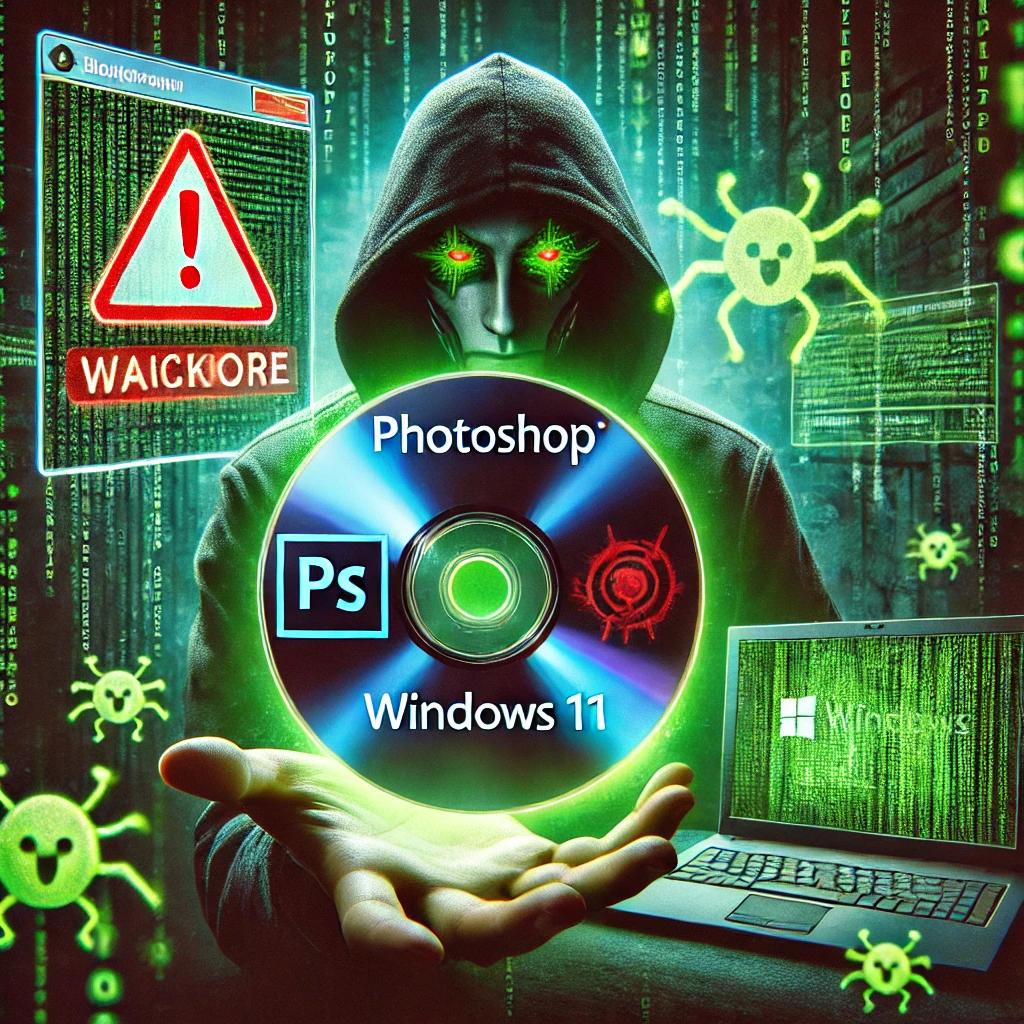
Pirated software 🏴☠️ accounts for about 40% of installed software in many developed countries, with this percentage estimated to be much higher in less developed countries.
The truth is that the trend of illegal or unlicensed software use is decreasing every year, although it still persists as a worldwide problem.
Most people tend to opt for pirated *software *(SW) for purely economic reasons.
However, the failure to take into account other compelling reasons means that many users end up installing programs that leave their devices in a highly vulnerable situation.
If we recall what we discussed in a previous article when we talked about the fingerprinting phase, when an attacker manages to penetrate a local area network (LAN) - for example, that of a home via *Wi-Fi -*the second step is usually to scan the entire IP range of the network with tools such as Nmap to find more active devices, ports and open services, as well as the software and versions used on each one.
The pirated SW, precisely because it is pirated, lacks important privileges, such as technical support and, above all, updates or security patches provided by the company that created it.
Consequently, when an attacker discovers that one of the devices on the network is using an outdated operating system (OS) **version **or a vulnerable service - Samba, SSH, RDP, FTP, etc. - he will target that gateway, exploiting the known vulnerabilities of thatunpatched *version *.
Without too much difficulty, and with a simple search on the Internet (or using automated hacking tools such as Metasploit Framework), you can find a multitude of exploits prepared to attack obsolete versions of the most widely used SW.
Therefore, even a novice hacker*(Script Kiddie*) could use this information to carry out his attack without much effort or knowledge.
When the attackers are not on the same LAN as the victim and could be, for example, on the other side of the planet, they often embed malware in PDF, Word, Excel, etc. documents to send them as attachments in phishing emails.
In this case, the attackers do not know if the victims have any pirated or outdated software, but, by playing on probability, they launch millions of malicious emails in the hope that a percentage of users will open the attachment.
If the application that opens it is outdated or pirated, the malware could be easily executed.
In any case, there are other compelling reasons not to use pirated SW, such as respect for Intellectual Property Law and copyright.
When this happens in private environments it is bad enough, but if a company does it, it is even more serious, as it exposes itself to inspections and considerable fines.
Even the telemetry of the pirated software itself could report this activity to the company that created the SW, which, following a complaint from the latter, would lead to penalties and a significant loss of reputation.
Moreover, every time non-original SW is used, not only is the economy of the developing company and the country in which it is taxed damaged, but also jobs necessary for the creation of applications and knowledge are put at risk.
Imagine, for example, a country like Russia or North Korea wanting to harm the economy of its biggest rival -the United States- (although with Donald Trump they now seem to be very close), where a large part of the technology companies dedicated to software development are concentrated.
These rivals could plan to “**crack**These rivals could plan to “crack” as many of their competitors’ applications as possible and spread the pirated SW throughout the network for people to download and use freely, preventing the U.S. company from earning revenue.
But these same actors could go further: in addition to harming the rival country economically, they could embed malicious code in the manipulated software so that users who install it end up infected and their computers become part of a botnet, turned into zombie computers.
When the time comes, such a network could be used to launch distributed denial of service*(DDoS*) attacks against any country’s infrastructure.
The irony is that most of this pirated SW “goes rogue” and includes instructions to circumvent the antivirus so that it does not stop the installation, asking the user to disable the antivirus during the installation and re-enable it at the end.
Naturally, by disabling the computer’s only security measure, the malware can get into the system as far as the kernel of the machine, where the antivirus does not usually look for it unless it is an anti-rootkit, which is unusual for non-expert users.
When purchasing SW, it is best to buy it from the manufacturer’s website, go to specialized stores or use the application stores that come pre-installed in many devices: Play Store, App Store, Microsoft Store, Deepin Store, etc.
Be wary of bargains and disreputable online stores.
It is true that, even in the official stores, thousands of applications have been discovered and removed that violated the platform’s policies - for fraudulent activities, radical change of their functionality in some update, excessive data collection without consent, etc. - but they still offer a higher level of supervision.
Regardless of where the application was obtained, we must never forget that the biggest danger is not having ALL software updated to the LATEST version.
If you do not have security patches because you are using a pirated copy, or if you do not configure your software to update automatically, the margin of exposure to attacks grows exponentially.
With software, it’s only a matter of time before someone finds a vulnerability that can be exploited.
Finally, I will leave you with the following recommendations:
- Comply with the law and do not use illegal software.
- Never trust pirated software: it almost always comes with a “bug” that can wreak havoc on your computer.
- Whether it’s a smart TV, a surveillance camera, a Wi-Fi plug, a computer or a phone, you should always make sure you have the software updated to the latest version. If, for some reason, the company that created it no longer exists or has stopped providing support, it is best to replace that device and no longer use it.
- Buy in official stores.